






















Home
News Center
Industrial Automation Controller Selection Criteria for OEMs

For an original equipment manufacturer (OEM), the controller you put inside your machine is not a component — it is the brain of the product you sell. It defines how your equipment performs, how it feels to operate, how long it lasts in the field, and how much it costs to build and support. Choose well, and the machine earns a reputation for reliability. Choose poorly, and every warranty claim, field failure, and performance complaint traces back to one decision.
Yet with dozens of platforms, processors, form factors, and vendors on the market, selecting the right industrial automation controller is genuinely difficult. This guide lays out the concrete selection criteria that matter most to OEMs, and explains how a thoughtful, customization-first approach produces dependable OEM solutions that stay competitive over a machine's entire lifecycle.
OEMs face a set of pressures that a generic computer buyer never sees. Your machines ship in volume, must perform identically across every unit, and must keep working in the field for years — often a decade or more. The controller is at the center of all of it:
· It determines machine performance. Motion control, vision processing, data logging, and HMI responsiveness all depend on the computing platform.
· It defines your bill of materials. The controller is often one of the most expensive single parts in an automated machine.
· It shapes your support burden. A controller that fails in the field means downtime for your customer and cost for you.
· It becomes part of your brand. The HMI experience, boot time, and industrial design are what operators remember about your machine.
Getting the controller right early is far cheaper than retrofitting it later. Re-engineering a control platform mid-production can delay launches, invalidate certifications, and break years of accumulated software work. That is why selection deserves a deliberate, criteria-driven process.
No single controller fits every OEM application. The right choice depends on a handful of technical and commercial dimensions. Here are the criteria that should anchor your uation.
Match the processor to the workload — but leave headroom. A control loop that only uses 40% of the CPU today may need 70% in a few years as you add features. For applications combining real-time control with vision or data analytics, look for multi-core industrial processors and platforms that can run a real-time operating system or hypervisor alongside a general-purpose OS.
Benchmark against your actual software, not synthetic scores. Cycle time, interrupt latency, and I/O throughput matter more than raw clock speed in most automation tasks.
Every machine has a specific set of inputs and outputs. Your controller must support the right mix of:
· Fieldbus and industrial protocols — EtherCAT, Profinet, EtherNet/IP, Modbus TCP/RTU, CANopen, and others.
· Discrete and analog I/O — digital inputs/outputs, analog channels, encoders, and motion interfaces.
· Serial and legacy ports — RS-232/422/485 that many sensors and drives still require.
· Networking — Gigabit Ethernet, Wi-Fi, 4G/5G, and USB for peripherals and IIoT uplink.
Consider not just what you need today, but what your next machine revision will need. Controllers with modular or expansion options give you room to grow without a full redesign.
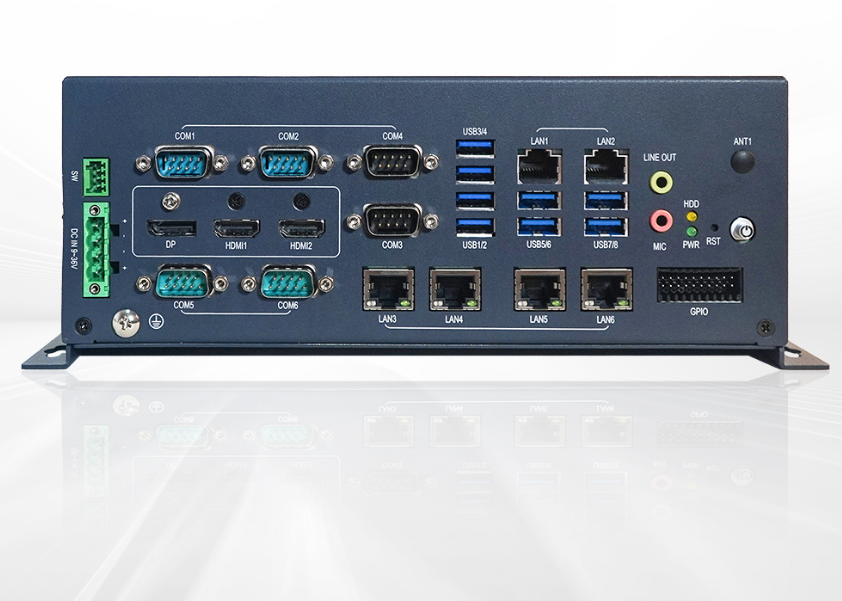
For OEMs, the controller must integrate cleanly into the machine's cabinet, cabling, and manufacturing process.
Industrial machines live in demanding environments. Evaluate the controller against the conditions your equipment will actually face:
· Temperature range — many OEM machines operate in plants from -20°C to +60°C or wider; fanless designs eliminate the moving parts most likely to fail.
· Vibration and shock — especially for machines with motors, pumps, and other moving components.
· Dust, humidity, and ingress — protection ratings such as IP30–IP65 matter for washdown or dusty environments.
· Power quality — wide-input DC power and protection against surges, brownouts, and transients.
Ruggedness is not just about survival — it directly drives your warranty and field-repair costs. A controller built to industrial standards fails less often, which means fewer service calls and happier customers.
This is one of the most important criteria for OEMs — and the easiest to overlook. Your machine's lifetime may be 10–15 years, but consumer-grade components are often discontinued within a few years. Choose a controller built on components with extended lifecycle support (typically 7–10 years) so you can ship consistent machines and support existing ones without forced redesigns.
Ask your supplier about:
· Component longevity — the expected availability of the CPU and key chips.
· Revision control — how the vendor communicates and manages changes, so your product stays stable.
· Long-term pricing — commitments that protect your margins over the product life.
A reliable supply chain is a competitive advantage. OEMs who lock in a controller with guaranteed availability avoid the costly, disruptive redesigns that plague competitors.
Off-the-shelf controllers rarely fit an OEM's requirements perfectly. That is where true OEM solutions come in — controllers that can be adapted to your machine rather than the other way around.
Look for a vendor who offers real customization, not just a catalog: modified I/O configurations, custom form factors, BIOS-level changes, pre-loaded software images, unique branding, and design-for-manufacturing support that matches your assembly process. The more the controller aligns with your machine, the fewer compromises you accept.
The controller acts as the central brain coordinating every subsystem of the OEM machine.
Hardware is only half the story. The controller must run your software stack reliably and be supportable for the life of the machine. Evaluate:
· OS and runtime support — Windows, Linux, real-time extensions, and the drivers you depend on.
· Driver and BSP availability — up-to-date board support packages that match your OS versions.
· Remote management — out-of-band management, diagnostics, and secure remote access for field service.
· Security — secure boot, TPM, and the ability to patch and maintain the platform over its life.
A controller that cannot be maintained becomes a liability. Confirm that the vendor can support your deployment through the full product lifecycle.
The purchase price is a fraction of the real cost. Calculate total cost of ownership across the machine's life:
· Engineering and integration cost — how much effort to integrate the controller into your design.
· Manufacturing cost — how easily it assembles into your cabinets and cables.
· Failure and warranty cost — driven by reliability and ruggedness.
· Redesign risk — avoided by choosing a platform with long-term availability.
In many OEM programs, a slightly more expensive controller that is more reliable and longer-lived is dramatically cheaper over the machine's lifetime.
To avoid analysis paralysis, work through a structured selection process:
1. Define the machine requirements first. Document performance, I/O, environment, software, and lifecycle needs before uating vendors.
2. Shortlist platforms, not just products. Compare controller families and vendors that can meet your base requirements.
3. Prototype with real software. Benchmark using your actual control application, not marketing specs.
4. Verify ruggedness with data. Ask for temperature, vibration, and MTBF documentation rather than assumptions.
5. Evaluate customization depth. Confirm the vendor can deliver the OEM solutions your machine truly needs.
6. Validate the supply chain. Lock in lifecycle, availability, and pricing commitments.
Key takeaway: The best industrial automation controller for an OEM is not the fastest or cheapest one — it is the platform that best fits your machine, survives your environment, lasts your product's lifetime, and adapts to your needs through genuine OEM solutions.
The controller you choose defines the performance, reliability, and longevity of every machine you ship. By uating processing headroom, I/O, ruggedness, lifecycle, customization, software support, and total cost of ownership — and working with a partner who delivers true OEM solutions — you build machines that perform consistently, survive the field, and stay competitive for years.
Whether you are launching a new product line or redesigning an existing one, a deliberate, criteria-driven approach to industrial automation controller selection is one of the highest-return investments an OEM can make.
Finally, remember that the relationship with your controller supplier is a long-term partnership, not a single transaction. The best vendors act as an extension of your engineering team — advising on component choices, helping you validate thermal and mechanical designs, and delivering OEM solutions that evolve as your machines evolve. Look for a partner with proven experience across industries similar to yours, responsive engineering support, and a track record of honoring lifecycle commitments in the field. A strong partner can shorten your development cycle, reduce risk, and help you bring better machines to market faster than you could alone.
And as automation trends advance — edge AI, predictive maintenance, more flexible and reconfigurable production lines — the right controller platform gives you a foundation you can build on rather than a dead end you have to replace. Platforms with headroom and open architectures let you add intelligence, connectivity, and new capabilities without ripping out the control system that already works. That forward-looking flexibility is precisely what separates a machine that stays competitive from one that becomes obsolete.




COPYRIGHT © EVOC.2026 ALL RIGHTS RESERVED.
