














Home
News Center
Edge Computing vs. Cloud Computing for Industrial IoT Applications

For decades, centralized cloud platforms have promised infinite storage, deep enterprise analytics, and global scalability. Yet on the factory floor—where a microsecond delay can mean a halted production line or a critical safety hazard—relying solely on a remote data center introduces unacceptable risks. This is where edge computing, powered by rugged industrial computers (IPCs) and intelligent controllers, transforms how modern industrial IoT (IIoT) systems operate.
To understand how edge and cloud computing coexist and compete, we must first examine their fundamental architectures on the plant floor.
· Cloud Computing: A centralized model where data flows from factory floor sensors, PLCs, and machines across public or private networks to remote server farms or hyperscale data centers. The cloud excels at macro-level operations: enterprise resource planning (ERP), historical data archiving, cross-site benchmarking, and large-scale AI model training.
· Edge Computing: A decentralized model that places computation, data filtering, and storage directly where data is generated—right beside the production line, inside robotic cells, or on rugged roadside infrastructure. In an industrial setup, edge systems utilize specialized hardware like the EVOC M60B or AIB-3600 to process sensor signals in milliseconds before any data ever touches an external network.
Evaluation Metric | Edge Computing (Industrial Edge / IPCs) | Cloud Computing (Centralized Servers) |
Latency & Response Time | Ultra-low (Sub-millisecond to milliseconds). Ideal for closed-loop control, robotics, and real-time machine vision. | High (Tens to hundreds of milliseconds). Subject to network jitter, bandwidth bottlenecks, and routing delays. |
Reliability & Uptime | High resilience. Continues to operate seamlessly during internet outages or WAN disconnections. | Dependent on connectivity. Requires a stable, continuous internet connection to function. |
Data Security & Sovereignty | High privacy. Raw operational data remains on-site behind factory firewalls; only aggregated metrics are synced. | Cloud-dependent security. Requires strict encryption and regulatory compliance for cross-border data transit. |
Bandwidth & Operating Cost | Optimized. Filters out noise locally, transmitting only essential insights upstream. | High recurring costs. Streaming gigabytes of raw, high-frequency sensor data 24/7 consumes immense bandwidth. |
Compute & Scalability | Bounded by physical hardware. Scaling requires deploying additional edge nodes or upgrading industrial servers. | Practically unlimited. Instantly scalable storage and elastic compute resources via API provisioning. |
While cloud platforms remain indispensable for executive dashboards and enterprise planning, four operational pressures explain why manufacturers are shifting intelligence to the edge:
In high-speed assembly lines, automated optical inspection (AOI), and multi-axis robotics, waiting for a round-trip to a cloud data center is impossible. If a defective component is detected on a high-speed conveyor, the sorting actuator must react in under 10 milliseconds. Edge computers process inference locally, ensuring instantaneous action.
Factory networks fail. Whether due to fiber cuts, ISP maintenance, or local switch failures, a cloud-dependent plant goes dark during an outage. Edge-capable systems—such as fanless industrial controllers deployed on 7x24 production lines—buffer telemetry locally, maintain autonomous control loops, and automatically sync data once connectivity is restored.
Streaming raw vibration data from thousands of bearings sampled at 10 kHz to the cloud creates staggering bandwidth bills and clogs corporate networks. Edge nodes process this data locally, running anomaly detection algorithms on-site and forwarding only compressed summary statistics or critical alarm flags. Furthermore, sensitive proprietary manufacturing parameters never leave the physical facility.
For many industrial workloads, the edge is not a convenience — it is a hard requirement. Here is why.
Industrial control is unforgiving about timing. A robotic arm, a high-speed packaging line, or a safety interlock cannot wait for a round trip to a distant data center, where network congestion, routing, and distance can add tens or hundreds of milliseconds. Edge computing delivers microsecond-to-millisecond response because the decision is made inches away from the machine.
A single machine can generate gigabytes of high-frequency sensor data per day. Multiply that by hundreds of machines across multiple plants, and the cost of transmitting and storing every raw reading in the cloud becomes significant. Edge computing filters and compresses locally — sending summaries, anomalies, and KPIs rather than the full firehose.
Factories cannot stop because a WAN link dropped. Edge devices can run autonomously, buffer data during outages, and resume synchronization when connectivity returns. This local autonomy is essential for production continuity and safety.
Many manufacturers — and an increasing number of regulators — require that sensitive process data stay on-site. Processing at the edge reduces exposure, keeps intellectual property inside the plant, and lets security policies be enforced at the network boundary rather than trusting every packet to the public internet.
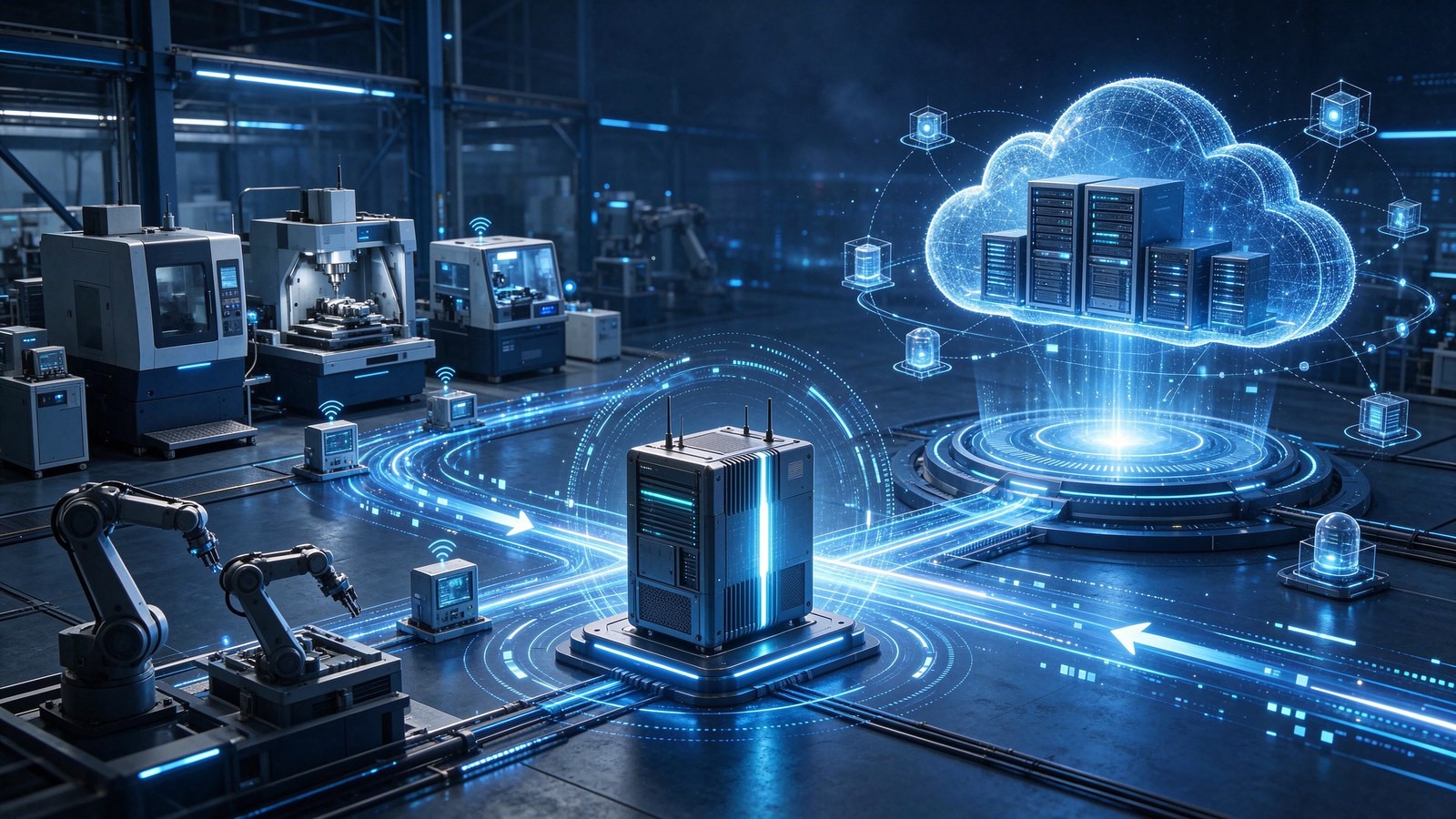
Deploying intelligence at the edge demands hardware engineered to withstand severe industrial environments—extreme temperatures, electrical noise, continuous vibration, and airborne particulate matter.
Leading this technological shift, EVOC Intelligent provides a comprehensive suite of rugged computing solutions tailored for edge deployment:
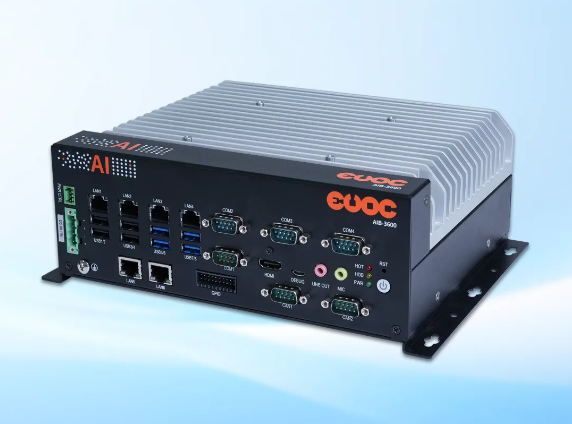
· EVOC AIB-3600: Powered by the NVIDIA Jetson AGX Orin platform, delivering up to 275 TOPS of AI performance in a fully sealed, fanless enclosure designed for millisecond-level decisions in embodied AI and multi-camera machine vision.
· EVOC M60B & M80B Series: High-performance industrial computing platforms engineered for multi-channel image acquisition, continuous 24/7 vision inference, and demanding production line monitoring.
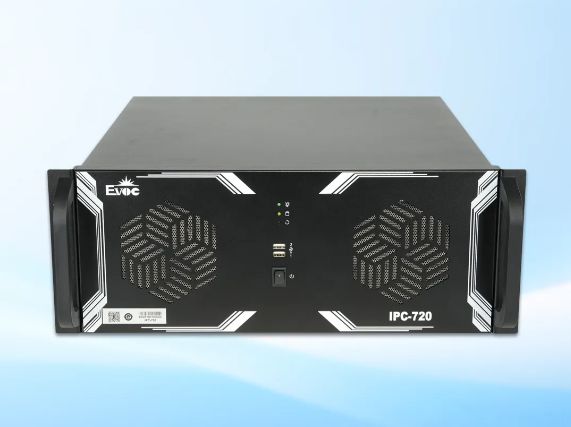
· EVOC IPC-720: A 4U rackmount GPU workstation built to support high-power accelerators, providing a robust on-premise compute foundation for deep learning and heavy industrial workloads.
The debate between edge computing and cloud computing in industrial IoT is ultimately about placing workloads where they deliver maximum operational value. By pairing the relentless processing power and reliability of industrial edge hardware with the expansive analytical depth of cloud platforms, manufacturers can achieve unprecedented agility, efficiency, and resilience.
Explore how EVOC's advanced industrial computers and edge controllers can transform your production line by visiting our Edge Computing Solutions Portal.




COPYRIGHT © EVOC.2026 ALL RIGHTS RESERVED.
