

























Home
News Center
What Kind of Industrial PC Can Withstand Hundreds of Hours of Non-Stop 3D Printing?

As 3D printing technology successfully produces aircraft engines that complete flight tests, the industry has clearly entered a new phase. 3D printing has moved beyond mere prototyping and is increasingly becoming a true main force in high-end manufacturing. Market reactions are even more direct. In 2025, the production volume of 3D printing equipment in China grew by 52.5%, confirming the breadth and speed of this transformation with remarkable momentum.
However, the door to large-scale industrialization doesn't simply swing open. A critical challenge stands in the way: When a single 3D print job can take hundreds of hours, how can we ensure this 'printing marathon' runs stably and error-free?
Pinpointing the Pain Point: A 'Printing Marathon' Where Failure is Not an Option
Imagine processing a complex workpiece via 3D printing, requiring machinery to operate continuously and precisely for over 300 hours. This presents an ultimate test of endurance for the stability of the control system, a test that traditional industrial PCs often fail.
· System Instability/Crashes: Any system crash, freeze, or lag during production can directly scrap a nearly finished workpiece, wasting both material and time.
· Supply Chain Risks: To ensure stability, many factories rely on foreign systems. This results in high procurement costs and slow replacement part delivery when failures occur, making it impossible to independently control the production rhythm.
· Difficulty Balancing Computing Power and Stability: Processing complex models demands significant computing power, yet ordinary computers struggle to deliver this performance reliably in demanding industrial environments over extended periods.
Simply put, when print times stretch from hours to hundreds of hours, system stability transforms from a "plus factor" into a fundamental baseline for survival—the very foundation upon which production feasibility rests.
Solution: Embedding a 'Stability Gene' into Manufacturing
So, how to address this? The 3D printing solution launched by EVOC integrates high-reliability embedded hardware (MGP-800) with an open control architecture, directly targeting the core pain points of the industry.
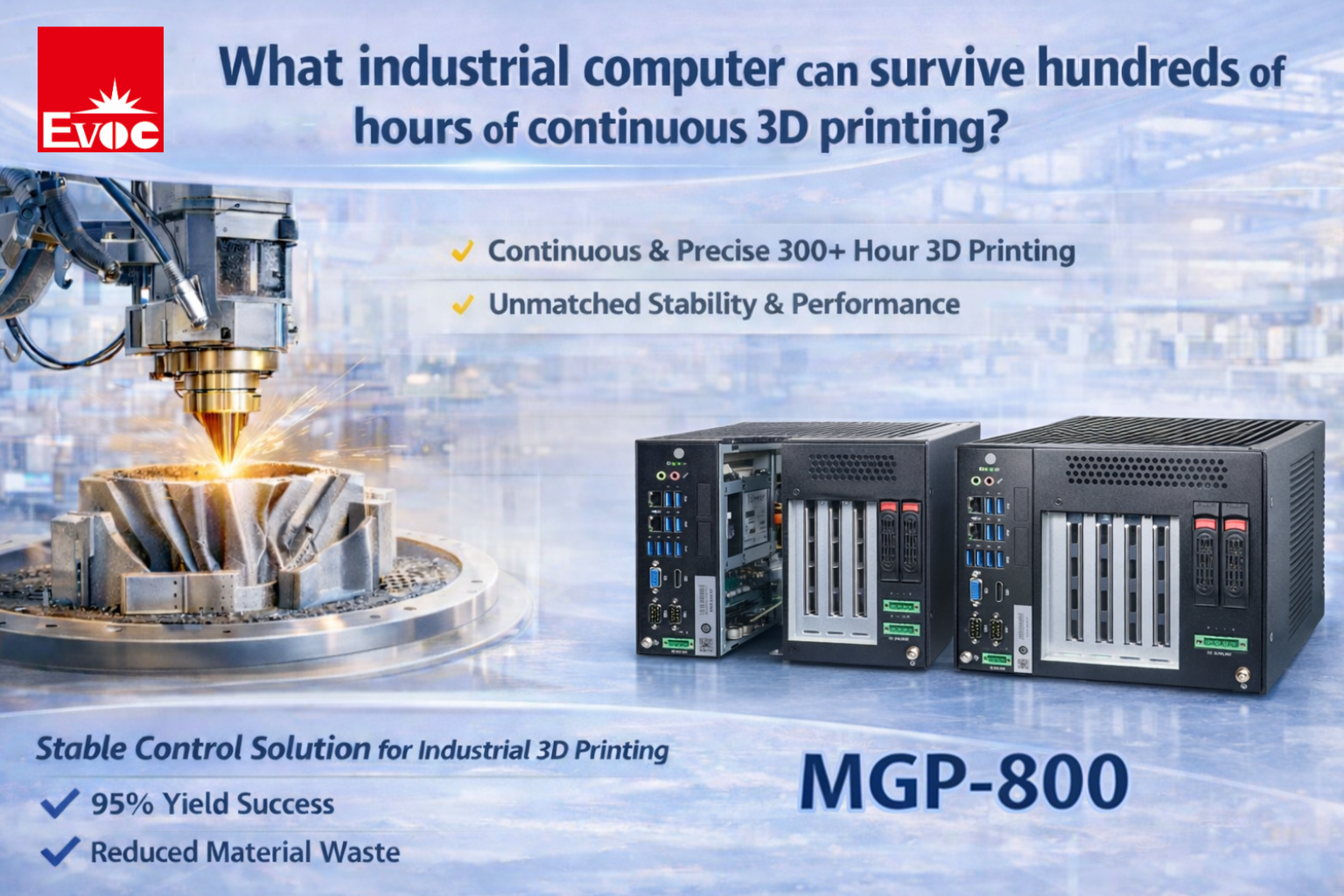
Using this as the control core, paired with high-precision motion control cards and motors, it achieves stable and accurate control over the entire printing process—from data processing to physical actuation, every step is reliable.
Customer Benefits: From Anxiety to 'Efficient Peace of Mind'
After a major domestic additive manufacturing company switched to using the EVOC MGP-800, they achieved tangible improvements in production efficiency.
· Production Autonomy and Control: Reduced reliance on single-source foreign technology, leading to more controllable procurement and maintenance costs, a more secure supply chain, and faster service response.
· Cost Savings Through Reliability: Improved system stability directly translated into higher printing efficiency. In practical application, the yield rate for high-end, complex components increased from over 80% to 95%. This alone saves millions of RMB annually in material waste reduction.
· Foundation for Innovation: The open hardware platform provides a stable and reliable foundation for subsequent process optimization and functional upgrades, helping enterprises build long-term technological advantages.
In today's pursuit of manufacturing limits, groundbreaking advancements often depend on foundational stability. As 3D printing unlocks ever more complex manufacturing possibilities, its future industrialization hinges on precision-enabling industrial cornerstones like the EVOC MGP-800.
In the world of high-end manufacturing, reliability is both the most basic prerequisite and the core competitive advantage.




COPYRIGHT © EVOC.2026 ALL RIGHTS RESERVED.
