
























Home
News Center
Energy Storage Monitoring: How Industrial PCs Enable Smart Grid Management

Battery energy storage systems (BESS) have become one of the fastest-growing assets in the modern energy landscape. They smooth the intermittency of solar and wind, provide fast frequency response, shift energy from low-price to high-price hours, and keep increasingly complex grids stable. But a battery is only as valuable as the intelligence that manages it. Every megawatt-hour of stored energy depends on precise, continuous monitoring and control — and at the center of that intelligence sits a rugged industrial PC.
This article explains the essential role of energy storage monitoring, how industrial PCs power smart grid management, and what to look for in the computing platform behind a modern BESS.
Energy storage is scaling quickly. Grid-scale batteries are deployed in containers packed with thousands of cells, while commercial and industrial (C&I) installations pair storage with rooftop solar to manage demand charges and backup power. The shift to renewables is accelerating this growth, because grids with high wind and solar penetration need storage to balance supply and demand in real time.
An energy storage system is demanding to operate. To run safely and profitably, operators must monitor, in real time:
· Cell-level state — voltage, temperature, state of charge (SOC) and state of health (SOH) across every module.
· Power conversion — the inverter/PCS (power conversion system) that charges and discharges the battery.
· Safety conditions — thermal management, ventilation, smoke and fire detection, and protection interlocks.
· Grid interaction — real-time frequency, voltage, and the dispatch commands from the grid operator or energy management system (EMS).
All of this data flows continuously, and it must be processed, displayed, logged, and acted upon at the edge — close to the battery itself. That is the job of energy storage monitoring.
A smart grid control center aggregates data from storage assets, renewables, and the network to balance supply and demand in real time.
Energy storage sites are not data centers. They are harsh, distributed, outdoor environments — often remote, exposed to temperature swings, dust, humidity, and unstable power. A consumer computer or a typical office server is not built for these conditions. This is precisely where the industrial PC earns its place.
Several characteristics make industrial PCs the natural platform for storage monitoring:
· Wide operating temperature. Energy sites can range from sub-zero winters to hot, sun-exposed containers. Industrial PCs are engineered for extended temperature operation with fanless, sealed designs.
· Fanless, rugged construction. No moving parts means fewer failure points, higher reliability, and resistance to vibration and dust in outdoor cabinets.
· Wide-input DC power. Storage sites run on DC systems with fluctuating voltage; industrial PCs accept wide input ranges and protect against surges and transients.
· Industrial I/O and protocols. Serial ports, CAN bus, and native support for Modbus, OPC UA, and other protocols connect directly to battery management systems (BMS), inverters, and meters.
· Long lifecycle. Energy assets operate for 15–20 years; industrial platforms offer the component longevity and stable supply needed to match.
In short, the industrial PC is built for exactly the environment where energy storage lives.
Smart grid management is the orchestration of generation, storage, and consumption across the network. It is a data problem: the grid operator needs accurate, timely information from thousands of distributed assets, and it needs to send back control decisions that keep the grid balanced and stable. Industrial PCs at storage sites are the crucial edge layer that makes this possible.
At the edge, an industrial PC continuously reads from the BMS, inverter/PCS, and meters — often over multiple industrial protocols simultaneously. It processes this data with low latency and executes local control logic: charge/discharge commands, thermal management responses, and safety interlocks that must act in milliseconds, not seconds.
Even when the connection to the central control room is interrupted, the storage site must keep operating safely. An industrial PC can host a local energy management system (EMS) that maintains autonomous control, monitors all safety parameters, and continues to protect the battery — then re-synchronizes when connectivity returns.
Modern smart grid management depends on the cloud, but sending every raw reading to the cloud is neither practical nor secure. Industrial PCs perform edge computing: aggregating, filtering, and analyzing data locally, then sending only relevant results and s to the cloud EMS. This reduces bandwidth, lowers latency, and keeps critical decision-making at the edge.
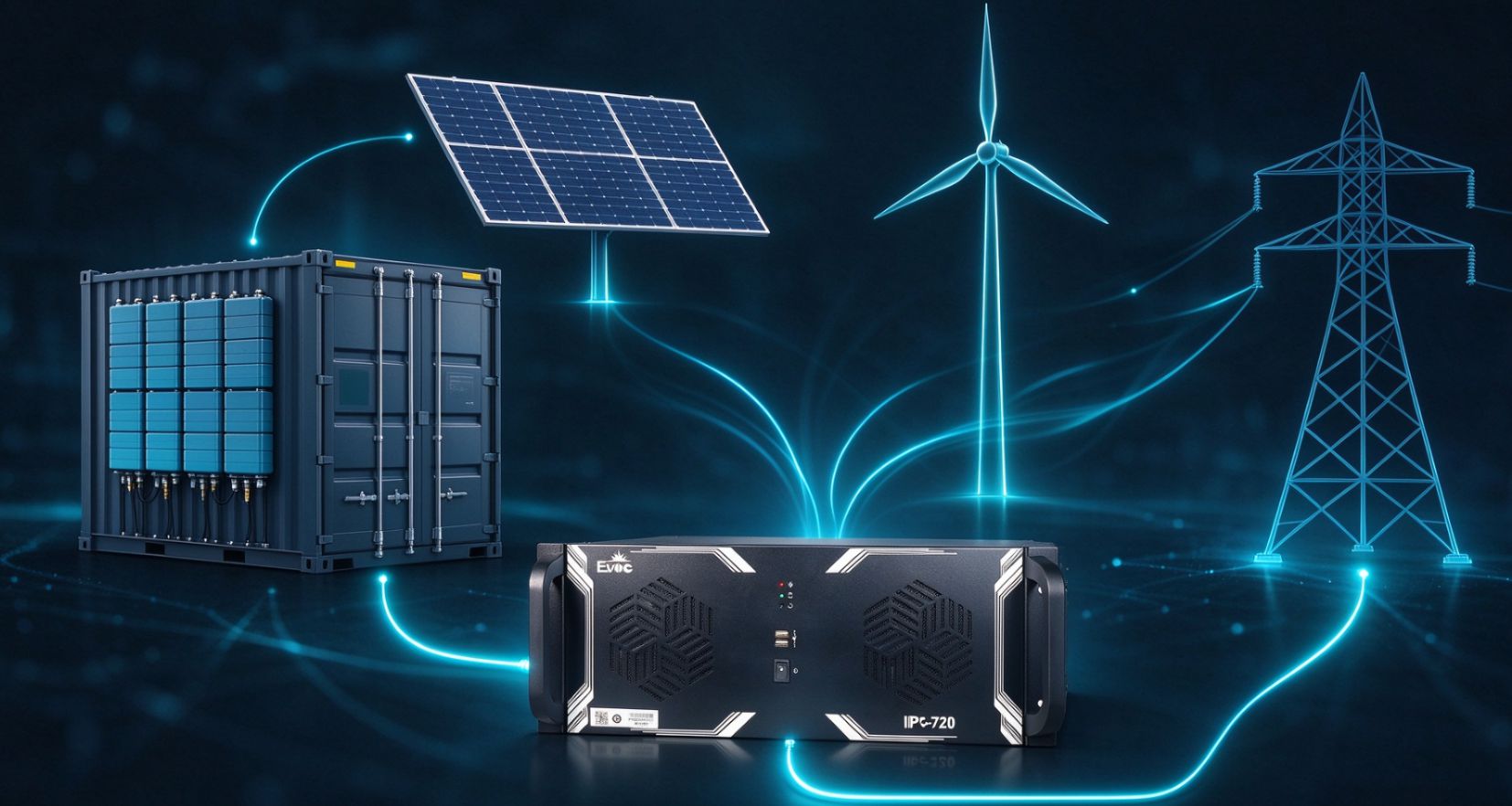
An industrial PC sits at the center of the storage site, connecting batteries, renewables, and the grid.
Energy infrastructure is critical infrastructure. Because an industrial PC is a network security appliance boundary in its own right, it can host security controls — firewalls, secure VPN gateways for remote access, encrypted communications, and secure boot — that protect the storage site from cyber threats. Isolation between the operational network and the corporate network is enforced at the edge.
For critical assets, the monitoring platform must be dependable. Industrial PCs can be configured with redundant power, watchdog timers for automatic recovery, and remote management for out-of-band diagnostics — all of which keep the storage asset online and monitored around the clock.
Battery operators depend on historical data to optimize performance and predict degradation. An industrial PC can run a local data historian that stores years of telemetry, and can host analytics models that estimate SOH, detect failing cells early, and recommend maintenance before a problem becomes a costly outage. By keeping this intelligence at the edge, the platform supports both immediate control and long-term asset management — a combination central to modern smart grid management.
Storage is rarely one big site; it is often many distributed units across substations, C&I facilities, and utility-scale plants. Industrial PCs are available in DIN-rail, panel-mount, and rack form factors, so the same computing core can be deployed consistently across all of them. This standardization simplifies integration, maintenance, and software management across an entire storage fleet.
Operating storage in the field comes with real-world challenges that the monitoring platform must be designed to absorb. Remote sites may lack climate-controlled rooms, so the controller must tolerate wide temperature swings without fans. Power can be noisy or intermittent during switching, demanding robust input protection and clean shutdown behavior. Connectivity to the control center can drop, requiring the site to continue safe autonomous operation. And because a BESS holds substantial energy, the monitoring system itself must meet the highest safety and reliability standards — a wrong reading or a delayed alarm is simply not acceptable.
These are exactly the conditions for which industrial PCs are engineered, and they are why leading energy storage integrators standardize on industrial computing rather than repurposed office hardware.
Not every industrial PC is suited to every storage project. When selecting a platform for energy storage monitoring, uate these factors:
· Processing performance — enough headroom for data acquisition, local EMS, and edge analytics simultaneously.
· I/O flexibility — the serial, CAN, Ethernet, and expansion options your BMS and inverters require, plus room to grow.
· Environmental ratings — operating temperature, ingress protection, and vibration resistance matched to your site.
· Power design — wide-input DC, redundant options, and transient protection for real site power conditions.
· Cybersecurity — secure boot, TPM, and the ability to host firewall and VPN functions.
·Long-term availability — extended component lifecycles and stable supply for the asset's 15–20 year life.
Key takeaway: In energy storage, the industrial PC is more than a computer — it is the trusted edge brain that keeps the battery safe, the site autonomous, and the grid informed. Choose a platform built for the harsh realities of the energy site, not for a server room.
As the world electrifies and renewables expand, energy storage monitoring and smart grid management will only grow more important. Batteries must be watched cell by cell, controlled in real time, and integrated into a grid that balances ever-changing supply and demand. Behind that capability is dependable edge hardware.
Rugged, fanless industrial PCs are the foundation that makes it all work — acquiring data, running local control, performing edge analytics, ensuring security, and staying reliable for decades in harsh outdoor environments. For energy storage operators and system integrators, choosing the right industrial computing platform is one of the most important decisions in designing a storage project that performs safely and profitably over its entire life.




COPYRIGHT © EVOC.2026 ALL RIGHTS RESERVED.
